Posts Tagged ‘horses’

The Post of Don Sam Incognito

February 18, 2009

Spring Training: Beginning Clicker

I had been taking our young dog to clicker training classes in the fall, and decided that it was time to try this method out on Mattie and Sam. I’ve been reading about it in horse books and on the web for some time now. It’s a form of classical conditioning–like Pavlov’s dogs, who were conditioned to respond to a bell. When I first heard about it, I felt that this was a method to take the art out of horse training, that it would make the horse’s response too mechanical, but three things have made me more open to trying it: taking Jeter to clicker class and seeing it work on dogs, learning that this method is used to train zoo animals to be handled for routine care, and, well, Mattie and Sam’s annoying habits.

I’ve done a little conditioning with them and find that they do respond to rewards better than other types of training. This seems obvious when I reflect on it–pleasure rewards more than pain. Last spring, Janet Zadina, the Brain Lady, who has branched out from her own neurological research to offer a synthesis of brain research applied to learning, came to Fairbanks to give a workshop. One thing I remember her telling us was that the brain functions better in pleasure than pain–in other words students learn more when they’re having fun and are engaged than when they’re anxious. This has profound implications for all levels of teaching, and it applies to horses as well.

Take Mattie, for example. When she arrived here, she was so anxious about simple things that she would pin her ears back and snake her neck at me when I brought hay. When working with her, I’m always reading her anxiety level and backing off a little when I seen her stressed nearly to the reaction point. Using pressure or pain to communicate with her is not only counterproductive but it’s dangerous. But with a pocketful of beet pellets–the reward is as much the crunchy sound they make as their food value–I can persuade her to do things she is worried about doing. In fact the first thing I taught her was to put her ears up on command, something I didn’t know I could teach her, like retraining an attitude. There are a few things we just haven’t really worked out yet, though, such as standing still at the mounting block. I’m hoping clicker training will help with this.

The first session with Sam went well. Nina was out for a “mentorship” opportunity, so she helped me with all the details. According to the clicker training website, it helps if you start with a target, training the horse not only to associate the clicker with a treat, but with an activity to complete before the treat is delivered. Ultimately this generalizes into a request for any activity that can be paired with the clicker.

That day, a week ago, it had warmed to 20 above; Nina and I stood in the snow, across the gate from Sam, who was haltered and on a lead rope. We showed him the clicker and he drew back, especially once we had clicked it. But we had beet pellets, so we clicked the clicker and offered the beet pellets and soon the click didn’t bother him. Then we introduced the Nancy’s Yogurt container. Nancy suggests right on the container that we should reuse it in some way, so we took her suggestion. We held it up to his nose and, when he had accidentally bumped the container, clicked the clicker and gave him a treat. He was a bit surprised to get a treat for nothing, and tried a number of things to get us to give him another one. He’s been taught to beg by turning his head away at the command, “wait,” so he tried that. He tried bumping us with his nose. We held the yogurt container up so he would bump it again, and, after a few tries, he was clearly bumping it deliberately to get the treat. Then we noticed that he would turn toward my coat pocket when I clicked the clicker–he knew where I kept the beet pellets.

We tried moving the container around and finally putting it on the ground, and he learned to bump it with his nose each time. He learned it so quickly that, as always with Sam, I had the sense that he’d done all this before. We stopped after about ten or fifteen minutes, so not to burn him out on the first attempt. When I tried it again a few days later, he remembered, and I could move the container around on the ground and he’d bump it and look at me. A good start. Now to figure out how to teach him something useful, like not bumping me with his nose while I’m leading or grooming him!

I tried this with Mattie today. She picked it up quickly, too, and would touch the container anywhere I put it. She clearly got that it was an action to get a treat, too, because she would do the behavior I’d already taught her, “ears up,” at the same time she was bumping the container. The clicker training people write about this process as like learning a mutual language that allows humans and animals to communicate. It did seem like Mattie, Sam, and I were doing something akin to Helen Keller’s first experience of connecting finger language with the meaning of water, opening the possibility of communicating her experience to others and vice versa.

More on this as spring training progresses.
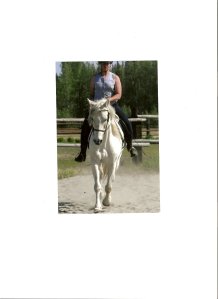
And the Horse

February 13, 2009

Excerpts from a work in progress:

from  Fear

So, does the horse somehow offer us courage? Is our attraction to the horse more than the size, the muscles, the flow of mane and tail? Children’s literature is full of stories of children, broken in some way: orphaned, injured, ignored–who find their strength through a horse. Take Walter Farley’s novels of Alec and the Black Stallion, a story that blends the most romantic images of the horse–the half-tamed stallion ridden by a small fatherless boy–with accurate details of the racing world in the 1950s. Alec loses his father in a shipwreck but gains the trust of the Black when they are marooned on desert island (OK. Romantic). When they arrive in New York, they partner up with a neighbor, a washed-up horse trainer, who retrains the Black for a career on the track. From there, except for the part were the Black wins every time, the details are accurate. Most of all, the details of how Alec learns courage, patience, determination, gentleness, and ingenuity from his life with the horse have moved children in the years since the books were published. And this lesson–when Alec was afraid, the Black lost trust in him; when he overcame his fear, the horse performed spectacularly–allowed children to contemplate their own relationship to fear.

Most riders don’t ride a horse like the Black, though most dream of it. Our fears are compounded by our history and by the life we live that doesn’t involve horses. Unless we raise a horse from a foal, we have no way of knowing what others have done or what accidents have torn the fabric of trust we hope will be woven between us and our horses. Those who work with horses are testing the limits of fear. We approach a new horse watchfully but not timidly. Will it kick? Bite? Shove us with head or hindquarters? We don’t want to be hurt, so we go slowly, watching for the first sign of anxiety in the horse, backing off, then trying again, until we have moved the boundaries of trust between us. The handler and the new horse need to prove to each other that each is trustworthy. The horse may see if we will back off, if it can call our bluff. The handler will test to see what’s bluff, what’s fear. Sam, my elderly horse, tries this on everyone he meets, though it’s clear to me that he means no harm by it–he’s even insulted if we give up and walk away. The goal is moving together like fish or birds do–one moves; the other moves with it in complementary motion, whether from the ground or as rider and horse

When a rider overcomes fear, that confidence may seem like folly to the non-horse person. Who would do the things a rider does? Lifting a horse’s feet, for example, or stopping it in its tracks with a raised hand, or longeing it at the end of a flimsy line while it bucks and crow hops after a long lay-off. Working with horses changes the measure of fear. We read our horses as minutely as they read us; if this holds to the rest of our lives, we are reading situations for their subtleties, knowing when to worry and when to keep grazing, when to trust the herd and when to be the one who sounds the alarm.

People want to visit my horses and I welcome them. Often, however, they are surprised at what they find. I try to teach them the simplest thing–hold a treat in an open palm and let the horse take it between its lips–a velvet kiss. This flies in the face of all the non-horse person’s fears. The large head of the horse lowers toward the hand, the breath of the horse warms the skin, the horse’s lips begin to flap in anticipation–and the person freezes, draws back, closes the hand. We try again. Mattie and Sam are patient, ritualistic about this. Then I can tell who has the courage of the horse in them. The horse’s lips on the palm are delicate, precise. They close on the treat and lift away like a large butterfly resting then rising from the palm. It’s a delicious feeling, and those who push aside their fears enough to experience it will want to offer the horse another treat.

And with horses and humans, that’s what defeats fear–the deliciousness of the whole enterprise. “The outside of a horse is good for the inside of a man (or woman)”, says (who? Washington?). We overcome our fears because what we gain is not just lack of fear, but an expanded sense of our selves, of possibility-the dream of the horse, and of shared enterprise, communication with another species whose history is linked with ours. Riding feels ancient and present at the same time. Standing next to a horse in a moment of stillness transcends time. Smelling a horse, lifting the mane and putting my nose in the shallow valley between neck and shoulder and inhaling, gives me courage to face whatever human catastrophes the day holds.

The View from Mattie’s Pillow

February 12, 2009

This morning, I was finishing throwing hay to the horses and spending a few minutes scratching their necks under their manes and inhaling their earthy, yeasty smell when the corral, the yard, the snow on the spruce trees began to glow with a copper light. It’s lighter every day now. The change is significant, the day extending by as much as an hour a week. The return of the light starts a fizz of energy in my stomach–or that place in the center of the body that the Chinese call chi. I look at the cutbank behind the house where I have been trying to get wildflowers to grow for the past six years. This year, I think, I’ll find a way.

Then the sun slipped up behind the clouds that spread across all the rest of the sky and the light dulled. Still, to the southern horizon there was a peachy band of light above the silhouettes of the mountains, then thick, flat grey.

I heard Obama’s speech the other night; like everyone else, I’ve been thinking of the economic situation, flattening the mood of delight I felt at the inauguration. I read about places where, already by last summer, people were abandoning horses in forests, in farmers’ fields, in empty horse trailers at horse shows or auctions. I even heard of horses found shot by owners who couldn’t keep them. Here in Alaska, we tend to feel the economic trends on a different cycle than the lower 48–sometimes by as much as five years. Still, we know it will impact us. We live in a place where extravagant living is unsustainable. In rural Alaska, the situation is more grim, as fuel prices went up in the fall just as rural communities needed to put in their winter supply. Some villages, like Emmonak, are in dire straits, but have found a way to make their plight–needing fuel and food–known and some relief has reached them.

I think about how things might go for us–including horse lovers and those working in the arts. We will keep on as long as we can, knowing that the things that sustain us are not all material or financial. Writing is an inexpensive art–though I’m writing on a laptop now, I could convert to pen and paper. Dance only takes the body and a sense of rhythm, though the production of a performance takes a whole lot more. Riding horses takes, well, the horse–and that’s more challenging here in the North than it might be in some more temperate place. It’s when we what to share our arts that the economy affects us the most. As the “recovery package” goes out around the country, I’m listening hard for reference to the arts, knowing that we will be dealing with some bread-and-butter issues first–but still, I’m listening.

I’m finishing this at night, the full moon of last night shaved a bit thinner now, and covered by the clouds still spread across the sky. The wood stove warms the room. The dog sleeps, a mound of brown fur.

The Post of Don Sam Incognito

February 9, 2009

About  Sam

Don Sam Incognito

Don Sam Incognito

Sam complains that Mattie gets all the glory on this blog–her face is on the masthead, Mattie’s Pillow is named after her, etc.–so I am giving him his own section to report on activities around the corral. Sam is an Andalusian, now in his twenties, who was brought to Alaska for reasons that are still a bit fuzzy to me. Perhaps someone from the Palmer area will read this and recognize him and help fill in the story. He came to our house as a rescue, lame in both front feet. Kathy, who had originally taken him in, didn’t have the right footing for a laminitic horse, and Mattie needed a pal, so we agreed to take him, even if we could never ride him.

When Kathy brought him to the house, he was walking on three legs, but was so strong in the back and haunches that he literally hopped, mostly on his hind legs, across the corral. We spent six weeks as fall drew on, soaking and packing his feet to draw out abscesses, cutting up blue foam insulation to the shape of his feet, and taping it to them with duct tape. We took a series of radiographs and trimmed his feet every week to ten days.

By spring, he was moving out on the lunge line and I was riding him lightly. By last summer-after fixing his digestive problems and pulling a broken tooth and floating the rest-he was fully himself: cranky, not suffering fools gladly, full of high spirits, and showing hints of the glorious Spanish-walking horse he probably once was. I’ve seen him do the Spanish walk–a goose-stepping walk where he throws one front leg forward, then another. It takes training and conditioning to reach this level; he does it for fun in the corral. When we first let him out of the smaller pen once his feet began to heal, he galloped around then came up to us and reared with his front legs neatly tucked and hopped toward us-three women with our mouths hanging open-taking three steps on his hind legs like a Lipizzaner in levade.

I call him Don Sam Incognito–a Spanish Don fallen on hard times who clearly thinks we’re all below him. This is his page.

Spring Training: Walk and Whoa

Yesterday, it warmed to above zero and the sun was bright. I went out with the Cowboy Magic detangler and spent some quality time detangling Sam’s mane, which hung in two long ropy tangles. Sam’s mane is nearly as fine as human hair, and tangles easily. It grows long and hangs down both sides of his neck. When I detangle it, rubbing the slippery gel into the tangles and meticulously picking the hairs apart one by one, he stands patiently, his head slightly bowed, not playing Nudge or the gelding game Nip You/Nip Me (the horse equivalent of slap hands).

Afterwards, with this mane hanging in waves, and his attention back on teasing me, we started spring training with Walk and Whoa. I walked with him on a loose line, then stopped abruptly (Whoa) and stood still from time to time. We did this all around the corral with a few chin bumps from the brass lead clip when Sam decided it was more fun to bump me on the shoulder or see if he could touch me with his teeth. Sam doesn’t try to bite; it’s all a game with him, and, if he ever touches me with his teeth, he quickly turns his head away. Still, I have been working on discouraging from this game, and he’s doing it less. From time to time, we backed up–or I made him back away from me. Then we moved forward. After we did this for a short time, I gave him a few beet pellets and let him go. Then I did the same with Mattie.

Mattie does not play games like Sam does. While he always seems to have mischief in his eyes, she often just looks nervous. Whatever happened to her when she was young (she was seven when we got her), she can become quite defensive when she anticipates pain; she has her ears cocked back nearly all the time. The first command we worked on was “ears up,” a cue for a behavior that most horses do naturally. For Mattie, ears up for a treat is a pose, a trick for begging. She will stand at the corner of the corral nearest the hay barn pointing her ears toward the hay, then looking over at me to be sure I’ve gotten the hint.

So Walk and Whoa with Mattie involves always reading her attitude. She walks beside me with her ears back. When we Whoa, she shows a bit of white at the eye. As long as she keeps a polite distance from me (2-3 feet), we are dong well. She is tuned in to me more than Sam–or differently. When I stop, she brakes and stops instantly. When we’ve been practicing this for a while, she’ll put her ears up for beet pellets at the Whoa. That’s progress.

Snow will be thick and packed down to ice in the corral for a couple of months now, and I don’t like to ride till we’re on dirt–late April early May. February is the time when I try new things in ground work and start longe work for fitness–theirs and mine as I walk an inner circle to their wider trotting circle. Sam longes like the pro he is. Mattie still gets confused. Last year we started her on long lining–two long reins , one looping under her tail, so I can hold both and walk a little behind and to the side of her, driving her from the ground. We got tangled up a lot last year.

This was a long post. I’ll post more of these, marking the progress or lack of progress as we move toward riding season. If you have thoughts or helpful hints on what I’m doing, please post a comment. I’m working with some experienced horse people here, but most of this I’m trying out on my own.

Tomorrow we start clicker training.

View from Mattie’s Pillow

February 4, 2009

Although it dipped back to 40 below in the valley along the river plains last night, it hovered around 25 below here–not quite blanketing temperatures for Mattie and Sam–and I promised myself I wouldn’t write about the cold. We’re tired of it here; tired of writing about it, tired of chopping wood, of worrying about ordering more fuel oil, of fiddling with cars that won’t start or run well.

Two days ago, Mike (who wanted me to mention him in this blog) went to start the truck and found that the engine block heater cord had melted at the plug. He first noticed some black soot on the ground under the truck, then followed the cord back to the melted plug and multiple outlet cord. I’m not sure I have all the technical terms right; it’s a thick yellow cord which has fan-shaped three-outlet end where cords to the engine block heater, the battery heater, and the oil pan heater plug in. The middle of this fan-shaped end, where the engine block heater cord plugs in, had melted, as had the plug. Lucky for us, they hadn’t melted through, or we would have discovered the truck in flames, as happened to a friend of ours a few years ago. She had parked her new-for-her car in the driveway one night, plugged in, and woke to find the charred and melted remains there in the morning.

Which brings me to why I live in Alaska. Thinking about groundhogs, lately, I remember that other places have less demanding seasons. Traveling to the East Coast to visit or for conferences, I always end up amazed at how tropical it seems–so many birds, deciduous trees, flowers, deer. When I remember the places I lived growing up–Eastern Shore Maryland, a barrier island in New Jersey, Southern Lancaster County Pennsylvania–I remember open spaces–fields, woods, stretches of winter beach–where I spent my time alone with my imagination. But each visit back there reminds me that those open spaces are gone or diminishing.

Two years ago, I went to New Jersey to visit my brother and rented a car to drive around the southern part of the state. He gave me directions to drive to a rural community to prove to me that there are still farms in Southern New Jersey. Caught in a line of cars on the highway, I ended up heading the wrong direction and took the next exit, hoping to get right back on and head the other way. I ended up in a little town with white frame houses and tree-lined streets, a town that hadn’t changed much in fifty years. I pulled into a gas station to ask directions. It was an old “service station” not a glass and metal chain self-serve. Inside, the office was dark from years of grease and cigarette smoke. A cluster of men sat there talking. They wore old ball caps and overalls, and had thick New Jersey accents-flat “a”s and broad round “o”s-sounds that had their roots in 17th century English of the early settlers, sounds I remember from childhood.

I asked for directions. They told me to just go down to the light and turn left; I’d get right back on the expressway. They didn’t tell me that the light was in the next town.

My brother was right. I found the farms and country roads, still narrow from the horse and buggy days, but clogged with cars going too fast. It was March, gloomy with rain mixed with snow. I couldn’t look anyplace without seeing people or buildings. Driving made me shake with anxiety, if only because nothing seemed automatic or familiar; I never knew where I was or if I would end up where I was intending to go.

Here, I look out my window and, on a clear day, see 150 miles to the Alaska Range: Mount Hess, Mount Hayes, Mount Deborah. Walking down the road from my house, I’m more likely to meet dog walkers than cars. Riding out on the horses in summer, I can see the Tanana River, braided and looping along its flood plain, gleaming among the dark spruce forests. In the week in late May/early June when we have our sudden spring, the birch and willow leaves uncurl into a glow of yellow-green, the pasque flowers appear on hillsides like fuzzy purple crocuses, the bluebells and wild roses bloom and the air is full of sweetness.

On her blog, Beyond Ester, Glow writes of the owl that landed in the spruce outside her window. We see foxes along the road and white snowshoe hares.  The brilliant light reflecting off the mid-day snow reminds us of the long light of summer.  Why would a small thing like cold make us want to leave this place?

View from Mattie’s Pillow

February 3, 2009


Groundhog Day and the temperature is sinking again, though there’s more light, brighter sun to give the illusion of approaching–so far away–spring.

The horses, the dog, and everyone I know are getting restless with the return of deep cold. Every afternoon around 4, as the sun slips behind the hill and the corral sits in pale blue light, Mattie and Sam play a game where they walk around their fenced areas (they each have half a corral, separated by metal portable panels) until they meet at the fence. The first one to reach the fence stretches his or her head over the top rail, open mouthed to nip at the neck or rump of the other. If the first horse makes contact, the other kicks at the fence, making a satisfying crash, then they both trot away, circling back at a canter and crow hopping till they get back to the fence where they go back to an oh-so-casual walk. I watched them do this for a half hour today.

The groundhogs didn’t agree on spring, I hear, and one even bit the mayor of New York on the hand. In another blog, I found a history of the holiday, Candlemas, a vague predictor of spring–but like the celebration of the solstice, an important marker for our hopes. I remember spring in Pennsylvania, growing up. About now, the ground would still be frozen, but towards the end of the month, it would tend toward mud. By March, there would be green in the lawns and pastures, and crocuses, with daffodils and tulips not far behind.

But here, spring is an abstract concept. In six weeks, mid-March, we will be nearly in the same light cycle as anywhere else in the Northern Hemisphere. For a few weeks, we all feel in synch with the places in the lower 48 many of us grew up in, except for the deep snow, the continuing cold, the possibility that we could still hit 30 below. Still the light glitters off the long-frozen crystals, birds flit between the trees, or cluster around the birch seed dusting the white ground, the ice carvers arrive for the annual competition, and the long-distance mushers return from the Yukon Quest, scraggly-bearded, hollow-eyed, triumphant, and ready to go out again.

But knowing that, somewhere, real groundhogs stir beneath the corn fields, imagining green shoots, gives me permission to look at seed catalogs for real and to imagine, again, what luscious things could grow in our short, intense season.

View from Mattie’s Pillow

February 1, 2009

Groundhog Day

More light now. The horses have time to doze in the sun without having to move as much to keep the light on their coats. We missed the deep cold we were scheduled for; we look at each other in the Post Office or at the grocery store or across the kitchen table and say how grateful we are that it’s only 20 below.

The town where I went to high school, Quarryville, Pennsylvania, had a social club, the Slumbering Groundhog Lodge whose members marched in local parades wearing choir robes and top hats, beating a bass drum, and proudly carrying a well-preserved stuffed groundhog. Every February 2, the Lodge went out in the corn fields to the official hole of Marmota Marmot (the official groundhog) and waited in the dark for the groundhog to appear. Every year, the local paper would report on the event-at 5:40 am, the groundhog would poke its nose out of the hole to see what all the fuss was about; a blinding flash of light would come from unexplained sources; the groundhog would duck back in the hole; and there would be six more weeks of winter. If the groundhog, for reasons known only to him, stayed above ground, it would only be six more weeks till spring. After the event, the Slumbering Groundhogs would trek back to their lodge to refill their flasks and warm up and report the news.

The Groundhogs had competitors, however, who believed that the only true sign of spring was the singing of the bull frog in the spring: The Singing Bull Frog Lodge. They wore green choir robes and would plan sneak attacks on the Slumbering Groundhogs in their lodge during the long winter months. Their reports of spring’s arrival were also reported in the paper. By then, of course, it was obvious to everyone-gardens and fields were tilled and seeded, the cows and horses were spread out, nibbling at the pastures, flowering trees-remember them?-were flowering.

Here in the Interior, the ground is somewhere below a couple feet of accumulated snow, fine and light on the top layer, packed densely as glacier ice close to the ground. We have no groundhogs. We have ground squirrels, regular squirrels, and voles. The ground squirrels hibernate; the tree squirrels live in the trees in nests made of scavenged material such as pink fiberglass insulation. The voles borrow in the hay barn, where they stash bits of dog food, bird seed, horse pellets. February 2 comes and goes, and if any of these critters pokes its head out, an owl may be the only one to know.

We putter on through winter, shoveling the driveway, chipping horse manure out of the snow and piling it, chopping wood for the stove, picking ice balls out from between the dog’s toes. But we hear the groundhog’s report-even if it’s the false groundhog from Punxatawney-and remember spring. I’ve bookmarked the garden seed sites; I’m saving yogurt containers for the greenhouse. Either way, I’ll be ready.

Poetry Challenge 5

January 30, 2009

This comes from a Creative Movement exercise today at the Effie Kokrine Science and Creative Expression class with Ruth Merriman from North Star Ballet. 

Negative space:

In art, this involves drawing what’s around the object, rather than the object itself; in dance, it’s using the shape of the space made by the movement or gesture of the body; in a poem, it’s writing about everything but the thing you’re focusing on–the objects, background, shadow, sounds, smells, textures, rather than the thing itself.  For examples see Gertrude Stein’s Tender Buttons.

So, choose an object.  Write about what’s all around the object or what it displaces.   Don’t mention the object.

Feb 3–

Here’s the poem I wrote today while working with the kids (we selected objects from a bag; mine was a horse bit):

Light glints on metal:
a bridge, a curve,
a circle of cold.
No leather attaches
but the soft gums
in the mare’s mouth
remember it even now.

The air chills
to its chill, light
bends to it;
a horse’s neck arches
and turns. Weight
and firm touch,
a bitter taste:
pennies, nickels
turned in the mouth,
a hard pebble
through which we
speak, then
trot on.

—————————-

Glow sent this:


Once,
making love under a ceiling fan,
my Beloved asked,
“what is that sound?”
A rattle, a misplaced hum,
a rasping breath,
an uneven gasp.
On the bed in the corner,
orange as a persimmon,
lay purring contentment.
Not a loose bearing after all.

View from Mattie’s Pillow

January 30, 2009

About dogs-for Glow:

The cold weather we dreaded hasn’t materialized. Tonight, when I went out to feed the horses, snow fell in fine white flakes through the floodlight on the peak of our house. Sam had a thick fleece of it along his back. Mattie, who had been in the shed, had a light powdered sugaring along her back and rump. The dog dashed around in the soft new snow, kicking it up behind him, rolling in it, nesting down, watching me cut open a new hay bale, waiting to see if I would feint his way so he could leap up and dash around me in long loops.

The dog is a young, nearly year old Standard Poodle pup. It surprises people who know me to learn that this is the new dog in my life. The dog before him, Kermit, my companion for 16 years was a mixture of three breeds: Shepherd, Corgi, and Lab–all big body, big bark, short legs. He had a talent for shedding on three twice-a-year cycles, one for each breed. He was hard headed, but my dog to the core. He had claimed me at the shelter when I wandered in full of skepticism to look for a dog. I was about to walk out when I saw a yellow dog in a pen, looking at me with recognition and urgency. I asked to see him; my guard was up. Then I felt his ears, the softest fur I had ever touched. I came back for him the next day and spent sixteen years trying to discern what that look was telling me.

I don’t know how to write about dogs the way I do about horses though dogs seem essential to a good life. Without one, there’s an empty space in the house, and it’s hard to know when strangers or anyone else drives up to the house without the barking. Dog training is a precise but playful activity, not edged with danger like horse training. A dog is an animal of manageable size: a head on the lap, a paw in the hand, a quick jog side by side–none of this is easy with a horse.

Tonight I took the poodle, Jeter, to get the last of a round of shots. He was ecstatic to go to the vet and, when I dropped the leash, ran from the car all the way up the stairs and sat waiting eagerly at the door of the vet’s office. He’s a shaggy mound of brown fur, still in his puppy cut, and he wiggled from tail to head as he greeted the attendants in the clinic. He has a habit of standing on his hind feet to hug people he hasn’t seen for a while (even if it’s me coming back from feeding horses), so he embraced all the humans in the clinic. There’s a toy poodle in the clinic, left there by former owners, now the clinic dog–a distant cousin, the size he was when he first came home with us. Jeter sniffed this dog then play-bowed to it hoping for a romp. She sniffed at him, then ducked under a chair.

When I posted the excerpt from the horse book yesterday, I wrote that dogs lie–that was Kermit, who never felt that he had been fed recently enough or been out on enough walks. But this young dog is eager, straightforward, gentle, earnest. Kermit always seemed ready to pick up a conversation left over from some previous life, as if he had been dropped suddenly into a dog’s body and wanted anyone who would pay attention to know about it. Jeter seems to love to be a dog and to bring us with him into a world of play: flying snow, wayward sticks, a game of tug now and then, and long walks. And he’s been running up on the hill where Kermit’s grave is, where the irises and delphiniums will blossom in the summer. Maybe he knows more than he lets on.

And the Horse (Excerpts from a work in progress)

January 28, 2009

The Beauties of the Animal Body

 Dogs lie–as any one who has fed a dog knows first hand. A dog will tell you he hasn’t eaten in weeks, that he didn’t hear you calling while he chased a car, that he’ll just die if you don’t scratch his ears right now. But look at a horse: that large body nearly ten times the size of ours, the eyes clear as glass at the corners of the head, the ears pointed up if he’s interested, pinned back if the situation’s not to be trusted. That body–all muscle, bone, and hoof–can move in an instant, bolting in fear or softening in trust. A horse doesn’t lie, though we may not know what he’s responding to, and, if you spend enough time around a horse, you begin to value his honesty in a complex and hard-to-predict world.

But if it were just that–cats don’t lie either, though interpreting their truth is another matter–it wouldn’t explain the power of the horse over our imagination. Is it the strength? A horse, after all, concedes to carry us on its back and more, to enter with us into the hopeful endeavor of training: to race other horses, or jump fences, or cut and rope cattle, or meander along a quiet road heading nowhere in particular. We ride other animals, elephants, for instance, but do they participate in our dreams for them?

The shape of the horse shapes our dreams of it. Those who breed horses pay attention to subtle shadings of conformation: the arch of neck, the set of the tail on the rump, the length of bone below the knee. Any horse-crazy child can tell you the difference between a Morgan and a Thoroughbred and a Quarter horse, though to a non-horse person, these are differences that seem insignificant–the subtle widening of the neck into the shoulder, a vertebra’s difference in the length of a back, the proportion of upper to lower leg. No one argues the existence of dog breeds. A poodle and a Corgi are recognizably different, for instance, and mutts come in such a variety that each one seems unique, even to the unattached.

But horses: it’s the body. Over the years, breeders have shaped the horse’s body to do what we need it to do, creating for us the knife-sleek body of the Thoroughbred or the bulked-up body of the Belgian or the flashy curves and gaits of the Morgan and its descendants: the Saddlebred and the Tennessee Walking Horse. To a horse person, these names evoke images of the shape of the horse, but that shape can’t be separated from action, so that breeds of horses are depicted in motion and recognized by that motion.

Then there are the color breeds: the Appaloosa with its white “blanket” and spots, the paint with its flashy white splotches and blue eyes, the palomino’s gold coat and creamy mane, the black, the gray, the “cremora”–in any breed. But breeding for color distracts us from what a true horse person loves about the horse–the way he uses his body and the way that motion fits with what we dream of doing.