Posts Tagged ‘not complaining’

The View from Mattie’s Pillow

February 19, 2009

Gray skies today. This morning, as the horses were eating their hay, snow began to fall in big flakes. The wind picked up–unusual for the Interior in winter–and the wind chimes on the deck began to rattle and ring. We’re hearing winter storm advisories on the radio, which means blowing snow at higher elevations–the domes and summits and ridges. Because we live in view of the highest mountain in North America, Denali, 170 miles away, none of the high points around Fairbanks are called mountains even though they would be mountains in other places, say Pennsylvania or Virginia. So we have Chena Ridge, where I live, or Murphy Dome, Ester Dome, Cleary Summit, Eagle Summit. Not mountains, but high enough to have their own micro weather patterns.

We’re more than half way through February, a bleak month in any temperate climate, but here, there’s an odd phenomenon where the returning light just begins to take effect–we have more energy and more daylight to do things in–but is counterbalanced by the persistence of winter. It was 27 below the other night, for example. The temperature dropped rapidly during the day, catching us unprepared. I had gone out to do some clicker work with Mattie and pretty soon had to go back in to warm my hands. The clicker is small and hard to click with gloves on, and I had reached the limit of cold in my fingers before they became painful. So I knew it was colder than 10 above, for at temperatures above that my hands can stay warm for a while from activity and from keeping the rest of me well wrapped. By today, it’s bounced back up above zero, but with wind and wind chill. So, in spite of the returning light, February is unreliable, and we stay in winter mode.

March is harder. There will be a few days that creep to near freezing (warm, by our standards). The light will be equal, day and night, and the sun bright on the snow. We gardeners gaze at our gardens; we can visualize the plants that will grow there in summer. Impatient, we will order seeds and starting soil and plant inside under lights or by a southern window. March is the month when we lose perspective. After Equinox, the days become longer by 7 minutes a day and we remember that flowers are blooming elsewhere. We don’t want to hear about it, really. We will still be sliding through stop signs and into ditches for another month. We will be plowing and shoveling snow and watching it slide off our roofs into mounds. And as the layers of snow melt, we will find all the gloves we thought we lost, or candy wrappers that fell from our cars at 40 below, or the spare change that fell. Not to mention dog poop and horse manure that got snowed over before we got out to clean it up. March is when we find out who the real survivors are by reading the divorce statistics in the newspaper.

The wind chime jingles again. The snow is marshmallow white; the corral looks pristine. Mattie and Sam stand in their shed, out of the wind, nipping at each other’s muzzles over the board wall that separates them. What am I thinking of? Flowers? Carrots? It’s still February.
The View from Mattie’s Pillow

February 12, 2009

This morning, I was finishing throwing hay to the horses and spending a few minutes scratching their necks under their manes and inhaling their earthy, yeasty smell when the corral, the yard, the snow on the spruce trees began to glow with a copper light. It’s lighter every day now. The change is significant, the day extending by as much as an hour a week. The return of the light starts a fizz of energy in my stomach–or that place in the center of the body that the Chinese call chi. I look at the cutbank behind the house where I have been trying to get wildflowers to grow for the past six years. This year, I think, I’ll find a way.

Then the sun slipped up behind the clouds that spread across all the rest of the sky and the light dulled. Still, to the southern horizon there was a peachy band of light above the silhouettes of the mountains, then thick, flat grey.

I heard Obama’s speech the other night; like everyone else, I’ve been thinking of the economic situation, flattening the mood of delight I felt at the inauguration. I read about places where, already by last summer, people were abandoning horses in forests, in farmers’ fields, in empty horse trailers at horse shows or auctions. I even heard of horses found shot by owners who couldn’t keep them. Here in Alaska, we tend to feel the economic trends on a different cycle than the lower 48–sometimes by as much as five years. Still, we know it will impact us. We live in a place where extravagant living is unsustainable. In rural Alaska, the situation is more grim, as fuel prices went up in the fall just as rural communities needed to put in their winter supply. Some villages, like Emmonak, are in dire straits, but have found a way to make their plight–needing fuel and food–known and some relief has reached them.

I think about how things might go for us–including horse lovers and those working in the arts. We will keep on as long as we can, knowing that the things that sustain us are not all material or financial. Writing is an inexpensive art–though I’m writing on a laptop now, I could convert to pen and paper. Dance only takes the body and a sense of rhythm, though the production of a performance takes a whole lot more. Riding horses takes, well, the horse–and that’s more challenging here in the North than it might be in some more temperate place. It’s when we what to share our arts that the economy affects us the most. As the “recovery package” goes out around the country, I’m listening hard for reference to the arts, knowing that we will be dealing with some bread-and-butter issues first–but still, I’m listening.

I’m finishing this at night, the full moon of last night shaved a bit thinner now, and covered by the clouds still spread across the sky. The wood stove warms the room. The dog sleeps, a mound of brown fur.

The Post of Don Sam Incognito

February 9, 2009

About  Sam

Don Sam Incognito

Don Sam Incognito

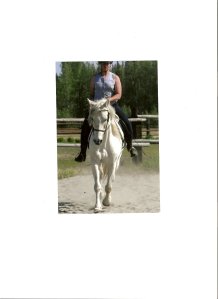
Sam complains that Mattie gets all the glory on this blog–her face is on the masthead, Mattie’s Pillow is named after her, etc.–so I am giving him his own section to report on activities around the corral. Sam is an Andalusian, now in his twenties, who was brought to Alaska for reasons that are still a bit fuzzy to me. Perhaps someone from the Palmer area will read this and recognize him and help fill in the story. He came to our house as a rescue, lame in both front feet. Kathy, who had originally taken him in, didn’t have the right footing for a laminitic horse, and Mattie needed a pal, so we agreed to take him, even if we could never ride him.

When Kathy brought him to the house, he was walking on three legs, but was so strong in the back and haunches that he literally hopped, mostly on his hind legs, across the corral. We spent six weeks as fall drew on, soaking and packing his feet to draw out abscesses, cutting up blue foam insulation to the shape of his feet, and taping it to them with duct tape. We took a series of radiographs and trimmed his feet every week to ten days.

By spring, he was moving out on the lunge line and I was riding him lightly. By last summer-after fixing his digestive problems and pulling a broken tooth and floating the rest-he was fully himself: cranky, not suffering fools gladly, full of high spirits, and showing hints of the glorious Spanish-walking horse he probably once was. I’ve seen him do the Spanish walk–a goose-stepping walk where he throws one front leg forward, then another. It takes training and conditioning to reach this level; he does it for fun in the corral. When we first let him out of the smaller pen once his feet began to heal, he galloped around then came up to us and reared with his front legs neatly tucked and hopped toward us-three women with our mouths hanging open-taking three steps on his hind legs like a Lipizzaner in levade.

I call him Don Sam Incognito–a Spanish Don fallen on hard times who clearly thinks we’re all below him. This is his page.

Spring Training: Walk and Whoa

Yesterday, it warmed to above zero and the sun was bright. I went out with the Cowboy Magic detangler and spent some quality time detangling Sam’s mane, which hung in two long ropy tangles. Sam’s mane is nearly as fine as human hair, and tangles easily. It grows long and hangs down both sides of his neck. When I detangle it, rubbing the slippery gel into the tangles and meticulously picking the hairs apart one by one, he stands patiently, his head slightly bowed, not playing Nudge or the gelding game Nip You/Nip Me (the horse equivalent of slap hands).

Afterwards, with this mane hanging in waves, and his attention back on teasing me, we started spring training with Walk and Whoa. I walked with him on a loose line, then stopped abruptly (Whoa) and stood still from time to time. We did this all around the corral with a few chin bumps from the brass lead clip when Sam decided it was more fun to bump me on the shoulder or see if he could touch me with his teeth. Sam doesn’t try to bite; it’s all a game with him, and, if he ever touches me with his teeth, he quickly turns his head away. Still, I have been working on discouraging from this game, and he’s doing it less. From time to time, we backed up–or I made him back away from me. Then we moved forward. After we did this for a short time, I gave him a few beet pellets and let him go. Then I did the same with Mattie.

Mattie does not play games like Sam does. While he always seems to have mischief in his eyes, she often just looks nervous. Whatever happened to her when she was young (she was seven when we got her), she can become quite defensive when she anticipates pain; she has her ears cocked back nearly all the time. The first command we worked on was “ears up,” a cue for a behavior that most horses do naturally. For Mattie, ears up for a treat is a pose, a trick for begging. She will stand at the corner of the corral nearest the hay barn pointing her ears toward the hay, then looking over at me to be sure I’ve gotten the hint.

So Walk and Whoa with Mattie involves always reading her attitude. She walks beside me with her ears back. When we Whoa, she shows a bit of white at the eye. As long as she keeps a polite distance from me (2-3 feet), we are dong well. She is tuned in to me more than Sam–or differently. When I stop, she brakes and stops instantly. When we’ve been practicing this for a while, she’ll put her ears up for beet pellets at the Whoa. That’s progress.

Snow will be thick and packed down to ice in the corral for a couple of months now, and I don’t like to ride till we’re on dirt–late April early May. February is the time when I try new things in ground work and start longe work for fitness–theirs and mine as I walk an inner circle to their wider trotting circle. Sam longes like the pro he is. Mattie still gets confused. Last year we started her on long lining–two long reins , one looping under her tail, so I can hold both and walk a little behind and to the side of her, driving her from the ground. We got tangled up a lot last year.

This was a long post. I’ll post more of these, marking the progress or lack of progress as we move toward riding season. If you have thoughts or helpful hints on what I’m doing, please post a comment. I’m working with some experienced horse people here, but most of this I’m trying out on my own.

Tomorrow we start clicker training.

View from Mattie’s Pillow

February 4, 2009

Although it dipped back to 40 below in the valley along the river plains last night, it hovered around 25 below here–not quite blanketing temperatures for Mattie and Sam–and I promised myself I wouldn’t write about the cold. We’re tired of it here; tired of writing about it, tired of chopping wood, of worrying about ordering more fuel oil, of fiddling with cars that won’t start or run well.

Two days ago, Mike (who wanted me to mention him in this blog) went to start the truck and found that the engine block heater cord had melted at the plug. He first noticed some black soot on the ground under the truck, then followed the cord back to the melted plug and multiple outlet cord. I’m not sure I have all the technical terms right; it’s a thick yellow cord which has fan-shaped three-outlet end where cords to the engine block heater, the battery heater, and the oil pan heater plug in. The middle of this fan-shaped end, where the engine block heater cord plugs in, had melted, as had the plug. Lucky for us, they hadn’t melted through, or we would have discovered the truck in flames, as happened to a friend of ours a few years ago. She had parked her new-for-her car in the driveway one night, plugged in, and woke to find the charred and melted remains there in the morning.

Which brings me to why I live in Alaska. Thinking about groundhogs, lately, I remember that other places have less demanding seasons. Traveling to the East Coast to visit or for conferences, I always end up amazed at how tropical it seems–so many birds, deciduous trees, flowers, deer. When I remember the places I lived growing up–Eastern Shore Maryland, a barrier island in New Jersey, Southern Lancaster County Pennsylvania–I remember open spaces–fields, woods, stretches of winter beach–where I spent my time alone with my imagination. But each visit back there reminds me that those open spaces are gone or diminishing.

Two years ago, I went to New Jersey to visit my brother and rented a car to drive around the southern part of the state. He gave me directions to drive to a rural community to prove to me that there are still farms in Southern New Jersey. Caught in a line of cars on the highway, I ended up heading the wrong direction and took the next exit, hoping to get right back on and head the other way. I ended up in a little town with white frame houses and tree-lined streets, a town that hadn’t changed much in fifty years. I pulled into a gas station to ask directions. It was an old “service station” not a glass and metal chain self-serve. Inside, the office was dark from years of grease and cigarette smoke. A cluster of men sat there talking. They wore old ball caps and overalls, and had thick New Jersey accents-flat “a”s and broad round “o”s-sounds that had their roots in 17th century English of the early settlers, sounds I remember from childhood.

I asked for directions. They told me to just go down to the light and turn left; I’d get right back on the expressway. They didn’t tell me that the light was in the next town.

My brother was right. I found the farms and country roads, still narrow from the horse and buggy days, but clogged with cars going too fast. It was March, gloomy with rain mixed with snow. I couldn’t look anyplace without seeing people or buildings. Driving made me shake with anxiety, if only because nothing seemed automatic or familiar; I never knew where I was or if I would end up where I was intending to go.

Here, I look out my window and, on a clear day, see 150 miles to the Alaska Range: Mount Hess, Mount Hayes, Mount Deborah. Walking down the road from my house, I’m more likely to meet dog walkers than cars. Riding out on the horses in summer, I can see the Tanana River, braided and looping along its flood plain, gleaming among the dark spruce forests. In the week in late May/early June when we have our sudden spring, the birch and willow leaves uncurl into a glow of yellow-green, the pasque flowers appear on hillsides like fuzzy purple crocuses, the bluebells and wild roses bloom and the air is full of sweetness.

On her blog, Beyond Ester, Glow writes of the owl that landed in the spruce outside her window. We see foxes along the road and white snowshoe hares.  The brilliant light reflecting off the mid-day snow reminds us of the long light of summer.  Why would a small thing like cold make us want to leave this place?