Posts Tagged ‘training horses’

And the Horse

February 13, 2009

Excerpts from a work in progress:

from  Fear

So, does the horse somehow offer us courage? Is our attraction to the horse more than the size, the muscles, the flow of mane and tail? Children’s literature is full of stories of children, broken in some way: orphaned, injured, ignored–who find their strength through a horse. Take Walter Farley’s novels of Alec and the Black Stallion, a story that blends the most romantic images of the horse–the half-tamed stallion ridden by a small fatherless boy–with accurate details of the racing world in the 1950s. Alec loses his father in a shipwreck but gains the trust of the Black when they are marooned on desert island (OK. Romantic). When they arrive in New York, they partner up with a neighbor, a washed-up horse trainer, who retrains the Black for a career on the track. From there, except for the part were the Black wins every time, the details are accurate. Most of all, the details of how Alec learns courage, patience, determination, gentleness, and ingenuity from his life with the horse have moved children in the years since the books were published. And this lesson–when Alec was afraid, the Black lost trust in him; when he overcame his fear, the horse performed spectacularly–allowed children to contemplate their own relationship to fear.

Most riders don’t ride a horse like the Black, though most dream of it. Our fears are compounded by our history and by the life we live that doesn’t involve horses. Unless we raise a horse from a foal, we have no way of knowing what others have done or what accidents have torn the fabric of trust we hope will be woven between us and our horses. Those who work with horses are testing the limits of fear. We approach a new horse watchfully but not timidly. Will it kick? Bite? Shove us with head or hindquarters? We don’t want to be hurt, so we go slowly, watching for the first sign of anxiety in the horse, backing off, then trying again, until we have moved the boundaries of trust between us. The handler and the new horse need to prove to each other that each is trustworthy. The horse may see if we will back off, if it can call our bluff. The handler will test to see what’s bluff, what’s fear. Sam, my elderly horse, tries this on everyone he meets, though it’s clear to me that he means no harm by it–he’s even insulted if we give up and walk away. The goal is moving together like fish or birds do–one moves; the other moves with it in complementary motion, whether from the ground or as rider and horse

When a rider overcomes fear, that confidence may seem like folly to the non-horse person. Who would do the things a rider does? Lifting a horse’s feet, for example, or stopping it in its tracks with a raised hand, or longeing it at the end of a flimsy line while it bucks and crow hops after a long lay-off. Working with horses changes the measure of fear. We read our horses as minutely as they read us; if this holds to the rest of our lives, we are reading situations for their subtleties, knowing when to worry and when to keep grazing, when to trust the herd and when to be the one who sounds the alarm.

People want to visit my horses and I welcome them. Often, however, they are surprised at what they find. I try to teach them the simplest thing–hold a treat in an open palm and let the horse take it between its lips–a velvet kiss. This flies in the face of all the non-horse person’s fears. The large head of the horse lowers toward the hand, the breath of the horse warms the skin, the horse’s lips begin to flap in anticipation–and the person freezes, draws back, closes the hand. We try again. Mattie and Sam are patient, ritualistic about this. Then I can tell who has the courage of the horse in them. The horse’s lips on the palm are delicate, precise. They close on the treat and lift away like a large butterfly resting then rising from the palm. It’s a delicious feeling, and those who push aside their fears enough to experience it will want to offer the horse another treat.

And with horses and humans, that’s what defeats fear–the deliciousness of the whole enterprise. “The outside of a horse is good for the inside of a man (or woman)”, says (who? Washington?). We overcome our fears because what we gain is not just lack of fear, but an expanded sense of our selves, of possibility-the dream of the horse, and of shared enterprise, communication with another species whose history is linked with ours. Riding feels ancient and present at the same time. Standing next to a horse in a moment of stillness transcends time. Smelling a horse, lifting the mane and putting my nose in the shallow valley between neck and shoulder and inhaling, gives me courage to face whatever human catastrophes the day holds.
The Post of Don Sam Incognito

February 9, 2009

About  Sam

Don Sam Incognito

Don Sam Incognito

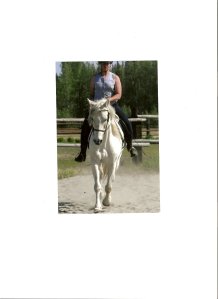
Sam complains that Mattie gets all the glory on this blog–her face is on the masthead, Mattie’s Pillow is named after her, etc.–so I am giving him his own section to report on activities around the corral. Sam is an Andalusian, now in his twenties, who was brought to Alaska for reasons that are still a bit fuzzy to me. Perhaps someone from the Palmer area will read this and recognize him and help fill in the story. He came to our house as a rescue, lame in both front feet. Kathy, who had originally taken him in, didn’t have the right footing for a laminitic horse, and Mattie needed a pal, so we agreed to take him, even if we could never ride him.

When Kathy brought him to the house, he was walking on three legs, but was so strong in the back and haunches that he literally hopped, mostly on his hind legs, across the corral. We spent six weeks as fall drew on, soaking and packing his feet to draw out abscesses, cutting up blue foam insulation to the shape of his feet, and taping it to them with duct tape. We took a series of radiographs and trimmed his feet every week to ten days.

By spring, he was moving out on the lunge line and I was riding him lightly. By last summer-after fixing his digestive problems and pulling a broken tooth and floating the rest-he was fully himself: cranky, not suffering fools gladly, full of high spirits, and showing hints of the glorious Spanish-walking horse he probably once was. I’ve seen him do the Spanish walk–a goose-stepping walk where he throws one front leg forward, then another. It takes training and conditioning to reach this level; he does it for fun in the corral. When we first let him out of the smaller pen once his feet began to heal, he galloped around then came up to us and reared with his front legs neatly tucked and hopped toward us-three women with our mouths hanging open-taking three steps on his hind legs like a Lipizzaner in levade.

I call him Don Sam Incognito–a Spanish Don fallen on hard times who clearly thinks we’re all below him. This is his page.

Spring Training: Walk and Whoa

Yesterday, it warmed to above zero and the sun was bright. I went out with the Cowboy Magic detangler and spent some quality time detangling Sam’s mane, which hung in two long ropy tangles. Sam’s mane is nearly as fine as human hair, and tangles easily. It grows long and hangs down both sides of his neck. When I detangle it, rubbing the slippery gel into the tangles and meticulously picking the hairs apart one by one, he stands patiently, his head slightly bowed, not playing Nudge or the gelding game Nip You/Nip Me (the horse equivalent of slap hands).

Afterwards, with this mane hanging in waves, and his attention back on teasing me, we started spring training with Walk and Whoa. I walked with him on a loose line, then stopped abruptly (Whoa) and stood still from time to time. We did this all around the corral with a few chin bumps from the brass lead clip when Sam decided it was more fun to bump me on the shoulder or see if he could touch me with his teeth. Sam doesn’t try to bite; it’s all a game with him, and, if he ever touches me with his teeth, he quickly turns his head away. Still, I have been working on discouraging from this game, and he’s doing it less. From time to time, we backed up–or I made him back away from me. Then we moved forward. After we did this for a short time, I gave him a few beet pellets and let him go. Then I did the same with Mattie.

Mattie does not play games like Sam does. While he always seems to have mischief in his eyes, she often just looks nervous. Whatever happened to her when she was young (she was seven when we got her), she can become quite defensive when she anticipates pain; she has her ears cocked back nearly all the time. The first command we worked on was “ears up,” a cue for a behavior that most horses do naturally. For Mattie, ears up for a treat is a pose, a trick for begging. She will stand at the corner of the corral nearest the hay barn pointing her ears toward the hay, then looking over at me to be sure I’ve gotten the hint.

So Walk and Whoa with Mattie involves always reading her attitude. She walks beside me with her ears back. When we Whoa, she shows a bit of white at the eye. As long as she keeps a polite distance from me (2-3 feet), we are dong well. She is tuned in to me more than Sam–or differently. When I stop, she brakes and stops instantly. When we’ve been practicing this for a while, she’ll put her ears up for beet pellets at the Whoa. That’s progress.

Snow will be thick and packed down to ice in the corral for a couple of months now, and I don’t like to ride till we’re on dirt–late April early May. February is the time when I try new things in ground work and start longe work for fitness–theirs and mine as I walk an inner circle to their wider trotting circle. Sam longes like the pro he is. Mattie still gets confused. Last year we started her on long lining–two long reins , one looping under her tail, so I can hold both and walk a little behind and to the side of her, driving her from the ground. We got tangled up a lot last year.

This was a long post. I’ll post more of these, marking the progress or lack of progress as we move toward riding season. If you have thoughts or helpful hints on what I’m doing, please post a comment. I’m working with some experienced horse people here, but most of this I’m trying out on my own.

Tomorrow we start clicker training.

And the Horse (excerpts from a work in progress)

January 23, 2009

Fear and the Horse

To learn about horses is to learn about what we fear and how much fear we can embrace. Think of it–a half-ton of muscle and bone, in personality more like a deer than a dog–and we propose to walk beside it or sit on its back. In the wild, a horse, by all rights, should fear us and we should fear it, too.

And many do. When strangers approach Mattie, I can see the level of their fear. They step back when she reaches her large head forward to sniff their scent. They are awed by her sixteen-hand size, her black coat, her noises. The image of the horse is one of compliance, grace, speed. The reality is an animal only partly tame–like a cat in some ways–whose psychology somehow allows us to work with it to form a braver more powerful team than either would be alone.

Because horses have such good memories, they remember things they fear for life. Horse people tell stories of the horse afraid of men in cowboy hats or of lawn chairs or of anything blowing along the ground. One of the puzzles of working with a new horse, especially one that has an unknown past, is to discover what it fears and to find a way to comfort it with the presence of the rider or handler. This is more easily written than done. A dog trainer once told me that it takes twenty-five repetitions for a dog to develop a learned habit–for that’s what training is–and fifty to seventy-five for a horse. A horse who is truly fearful can be in retraining for years. And all it takes is one bad experience to set it back into fear again, for the memory of fear is stronger than all that training.